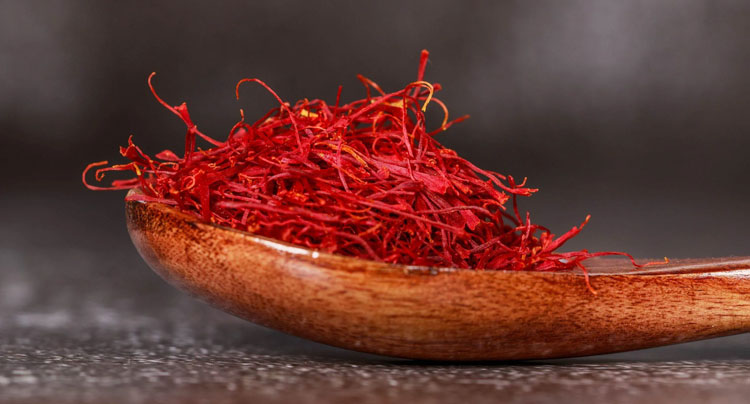













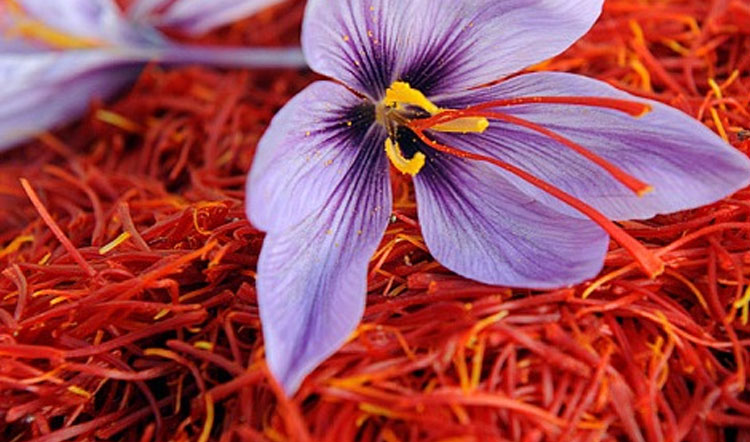
Saffron is a spice derived from the flower of Crocus sativus, commonly known as the “saffron crocus”. The vivid crimson stigma and styles, called threads, are collected and dried for use mainly as a seasoning and colouring agent in food. The saffron crocus was slowly propagated throughout much of Eurasia and was later brought to parts of North Africa, North America, and Oceania.
Saffron’s taste and iodoform-like or hay-like fragrance result from the phytochemicals picrocrocin and safranal. It also contains a carotenoid pigment, crocin, which imparts a rich golden-yellow hue to dishes and textiles. Its recorded history is attested in a 7th century BC Assyrian botanical treatise,[4] and it has been traded and used for thousands of years. As of 2018, Iran produced some 88% of the world total for saffron. Saffron has long been the world’s costliest spice by weight.
Cultivation
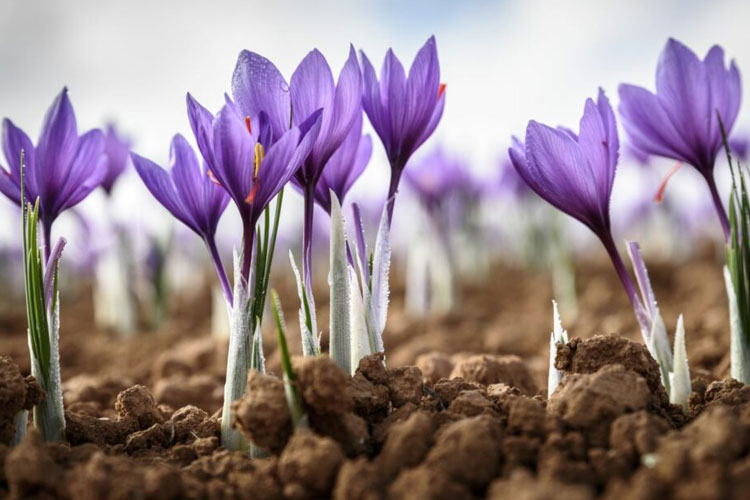
The saffron crocus, unknown in the wild, probably descends from Crocus cartwrightianus. It is a triploid that is “self-incompatible” and male sterile; it undergoes aberrant meiosis and is hence incapable of independent sexual reproduction—all propagation is by vegetative multiplication via manual “divide-and-set” of a starter clone or by interspecific hybridisation.
Crocus sativus thrives in the Mediterranean maquis, an ecotype superficially resembling the North American chaparral, and similar climates where hot and dry summer breezes sweep semi-arid lands. It can nonetheless survive cold winters, tolerating frosts as low as −10 °C (14 °F) and short periods of snow cover. Some reports suggest saffron can tolerate an air temperature range from −22 to 40 °C. Irrigation is required if grown outside of moist environments such as Kashmir, where annual rainfall averages 1,000–1,500 mm (40–60 in); saffron-growing regions in Greece (500 mm or 20 in annually) and Spain (400 mm or 16 in) are far drier than the main cultivating Iranian regions.
Harvesting
The high retail value of saffron is maintained on world markets because of labour intensive harvesting methods, which require some 440,000 hand-picked saffron stigmas per kilogram (200,000 stigmas/lb) – equivalently, 150,000 crocus flowers per kilogram (70,000 flowers/lb). Forty hours of labour are needed to pick 150,000 flowers. One freshly picked crocus flower yields on average 30 mg of fresh saffron or 7 mg dried; roughly 150 flowers yield 1 g (1⁄32 oz) of dry saffron threads; to produce 12 g (7⁄16 oz) of dried saffron, 450 g (1 lb) of flowers are needed; the yield of dried spice from fresh saffron is only 13 g/kg (0.2 oz/lb).
11. Gifts for special one should be redirected to the respective , men’s and women’s section on clicking
For example : Drape in her luxury will be redirected to women section.